

2026 Must Be the Year We Act – Not the Year We Look Away…
- Jan 5
- 2 min read

As we begin 2026, the Youth Charter does so with a heavy heart, but with an unwavering resolve.

The end of 2025 saw 33 Young Lives Lost across the UK and Ireland, each one a child, a sibling, a friend, a future stolen far too soon. These are not statistics. They are names, faces and families forever changed. The loss of Aria Thorpe, aged just nine, killed in December, must mark a line in the sand for our society. If it does not, then we have collectively failed.

Despite a year in which the Government launched more youth strategies, policies and reviews than any administration before it, young people continue to die on our streets. This reality demands honesty: policy volume without cohesion, coordination and community-level delivery is not enough.
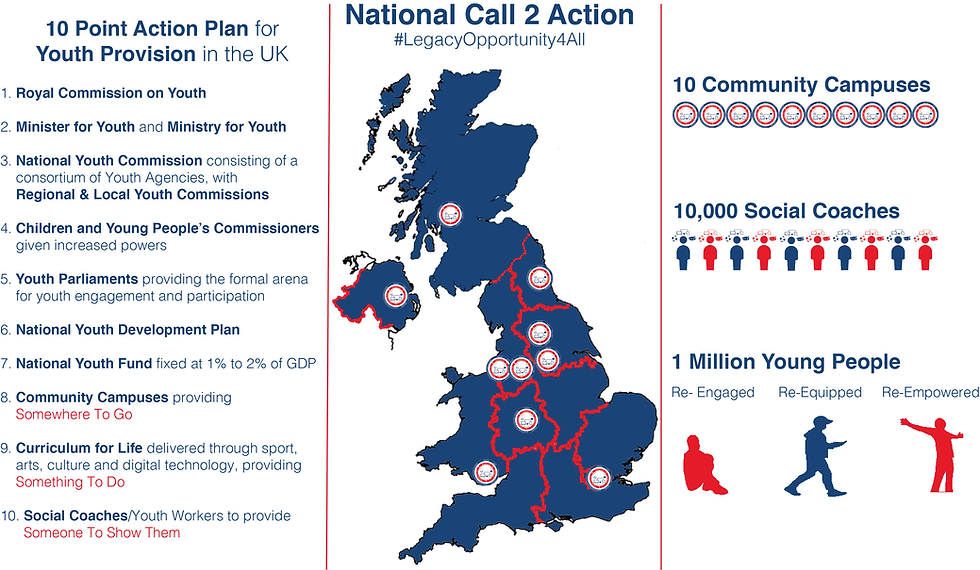
There has never been a more important or more timely moment to respond to the Youth Charter’s long-standing call for a National Commission on Youth, or indeed a Royal Commission on Youth, to bring together government, local authorities, education, policing, health, sport, culture, the voluntary sector and the private sector around a single, coherent national mission.
This call is reinforced by leadership at the very highest level. His Majesty The King has spoken directly about violence and knife crime, convening summits and urging action. Public figures such as Idris Elba have shown what is possible when influence, culture and social responsibility are aligned. But symbolism alone will not save lives. Coordination, investment and accountability will.
It can never be acceptable that, in a nation pursuing a national strategy on Violence Against Women and Girls, a nine-year-old girl loses her life to violence and we do not fundamentally change how we respond. The continued loss of young lives- 33 in one year alone, despite countless charities, programmes and initiatives- tells us something is broken.
The answer cannot be fragmented, short-term or performative.
For over three decades, the Youth Charter has campaigned, lobbied, advocated and delivered practical solutions rooted in sport, arts, culture and digital technology as powerful tools of enrichment, prevention and hope. Our National Call to Action and Community Campus model are not theoretical- they are alive, being implemented, and delivering impact where young people live.
These enrichment pathways are not “soft options”. They are a vaccine and antidote to the social, cultural and economic inequalities that fuel violence, exclusion and despair. They represent a smarter, fairer and more cost-effective approach to prevention than responding only after tragedy strikes.
As we enter 2026, the Youth Charter renews its call for a just, fair and equitable national response. One that recognises that saving young lives is not the responsibility of one sector alone, but of all of society working together.
The fight for our streets continues.
But it must now be matched by the courage to act differently, together, and at scale.
Enough lives have been lost.
2026 must be the year we turn commitment into coordinated action.


Comments